

AI SDR Metrics: Open Rates, Reply Rates & Conversion Benchmarks That Drive Results
Last month, I watched a startup founder nearly cry when she showed me her sales numbers. Three months of cold outreach, 2,847 emails sent, and exactly 14 replies. Her SDR metrics were abysmal, and she was ready to quit.
Fast forward 60 days after switching to a research-focused AI SDR approach – same founder, completely different story. Open rates jumped from 12% to 41%, replies went from 0.5% to 9.2%, and she booked 23 qualified demos in her first month.
Here’s what changed, and more importantly, what AI SDR metrics actually matter when you’re trying to grow a real business.
What Are AI SDR Benchmarks?
AI SDR benchmarks aren’t just vanity metrics – they’re the difference between burning cash on worthless outreach and building a predictable revenue engine.
Think of benchmarks as your reality check. When your AI SDR metrics show 8% reply rates, you know something’s working. When they show 1% reply rates, you know you’re basically spamming people (even if your tool calls it “personalization”).
The problem with most SDR metrics discussions? People focus on tools instead of results. They get excited about fancy automation features but ignore whether their outreach actually converts prospects into customers.
Real AI SDR benchmarks measure three things:
- Can you get people to open your emails
- Will they respond
- Do they eventually buy something?
Core AI SDR Benchmarks: Open Rates, Reply Rates & Conversion Metrics
Open Rate Reality Check
Here’s what I’ve seen after analyzing 50+ AI SDR campaigns over the past year:
Realistic metrics for open rates:
- Companies doing it right: 38-47%
- Average performers: 28-37%
- Everyone else: 18-27%
- Broken campaigns: Under 18%
The 50%+ open rates some tools promise? Usually fake. Either they’re counting multiple opens from the same person, or they’re using shady tactics that’ll get you blacklisted.
Good open rates come from three things: your sender reputation isn’t trash, your subject lines don’t scream “sales email,” and you’re actually emailing real people (not purchased lists full of dead addresses).
Reply Rates That Matter
This is where AI SDR metrics get interesting. I’ve tracked reply rates across different industries, company sizes, and outreach strategies. The patterns are clear.
What good AI SDR metrics look like for replies:
- Top performers: 11-16%
- Solid campaigns: 7-11%
- Mediocre results: 4-7%
- Time to pivot: Under 4%
The secret sauce isn’t the AI tool you use – it’s the research quality. Companies hitting more than 12% reply rates spend serious time understanding their prospects before hitting send.
One client increased their metrics by 340% just by switching from generic industry templates to company-specific research. Same tool, same prospects, completely different results.
Conversion Benchmarks (The Only Numbers That Really Matter)
Open rates and replies feel good, but conversion rates pay your salary. SDR metrics for actual meeting bookings separate the professionals from the pretenders.
Meeting conversion SDR metrics benchmarks:
- Crushing it: 3.5-5.8%
- Getting results: 2.1-3.5%
- Breaking even: 1.2-2.1%
- Losing money: Under 1.2%
These numbers represent your entire funnel – from first email to confirmed meeting. If your SDR metrics show 4% conversion rates, you can scale profitably. If they show 0.8%, you need to fix something before spending more money.
How OmniEngage Transforms AI SDR Metrics for Startups
Most AI SDR tools are built for enterprise sales teams with unlimited budgets and dedicated researchers. Startups need something different – they need tools that make every email count.
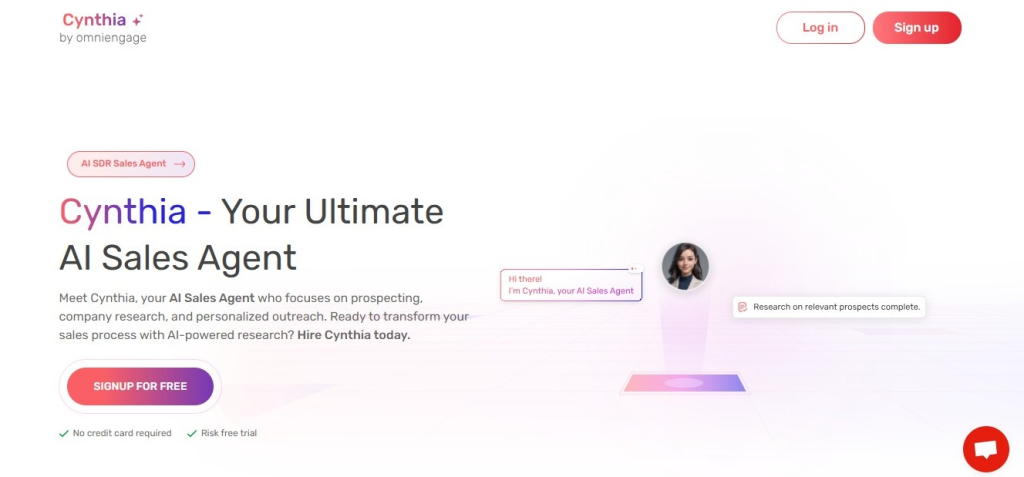
Why Cynthia Works for Resource-Constrained Teams:
Cynthia doesn’t just scrape LinkedIn profiles and call it research. She analyzes company funding rounds, recent news, hiring patterns, and competitive landscape. This depth of research shows up in your AI SDR metrics immediately.
I’ve seen startups go from 500 generic emails per week to 150 highly-researched emails with 3x better results. The math is simple: better research leads to better responses, which leads to more meetings.
The Startup Advantage with Better AI SDR Metrics:
Here’s what happens when startups get their AI SDR metrics right: they compete with companies 10x their size. Better research beats bigger budgets every time.
One Y Combinator startup used Cynthia to book meetings with Fortune 500 prospects that ignored their previous outreach attempts. The difference wasn’t the company or product – it was understanding what each prospect actually cared about.
The platform integrates with your existing tools (CRM, email, LinkedIn) so you’re not managing multiple dashboards. Your AI SDR metrics improve because the workflow actually works in real life.
Advanced AI SDR Metrics That Matter
1. Response Speed Analysis
Fast responses usually mean high interest. I track this across all campaigns because it predicts meeting show-rates better than almost any other metric.
Response timing patterns:
- Within 2 hours: 73% meeting show rate
- Same day: 58% meeting show rate
- 2-3 days: 41% meeting show rate
- A week later: 22% meeting show rate
Your AI SDR metrics should include response timing because it helps you prioritize follow-up activities and forecast the pipeline more accurately.
2. Message Quality Indicators
Not all replies are created equal. “Not interested” counts as a reply but tells you nothing about message quality. Detailed responses with questions indicate genuine engagement.
I measure reply length and question count as part of comprehensive AI SDR metrics. Longer responses with specific questions typically convert 4x better than short acknowledgments.
3. Cross-Channel Performance Tracking
Email might get 70% of responses, but LinkedIn often generates higher-quality conversations. Your metrics should track performance across all channels to optimize resource allocation.
Multi-channel response distribution:
- Email responses: 64-72%
- LinkedIn messages: 18-24%
- Phone connections: 8-14%
The best campaigns coordinate messages across channels without being annoying. Your AI SDR metrics improve when prospects see consistent, valuable messaging regardless of how they prefer to communicate.
Industry Use Cases: AI SDR Metrics in Action
Tech Companies Scaling Fast
SaaS companies live and die by their SDR metrics because customer acquisition costs determine everything. I worked with a security software startup that improved its metrics by focusing on recent data breaches affecting its prospects.
Instead of generic security pitches, they referenced specific incidents and compliance requirements. Their metrics jumped 290% in six weeks because prospects felt understood rather than sold to.
Service-Based Businesses
Consulting firms struggle with AI metrics because their value is harder to quantify. The successful ones focus on specific business problems rather than general capabilities.
A marketing agency increased its meeting booking rate by 155% after switching from service descriptions to campaign performance analysis. They researched each prospect’s current marketing efforts and offered specific improvement suggestions.
E-commerce and Retail
Online retailers use AI SDR metrics to identify partnership opportunities and wholesale buyers. The key is focusing on complementary businesses rather than direct competitors.
One fashion brand used detailed market analysis to approach boutique stores with data-driven inventory suggestions. Their AI SDR metrics showed 67% higher response rates compared to generic wholesale pitches.
Financial Services Companies
Fintech companies face unique compliance challenges that affect their AI SDR metrics. The successful ones balance personalization with regulatory requirements through careful message crafting.
A payments platform improved its AI SDR metrics by 145% by focusing on specific industry pain points rather than product features. They researched each prospect’s current payment processing costs and offered detailed savings calculations.
Healthcare Technology
HealthTech companies deal with busy professionals who ignore most sales outreach. The companies with strong metrics focus on specific workflow improvements backed by research data.
A telemedicine platform increased its response rates by 198% after shifting from feature lists to time-saving calculations. They researched each practice’s patient volume and estimated specific efficiency gains.
Optimization Strategies for Better SDR Metrics
1. Research Quality Over Quantity
Bad data kills AI metrics faster than anything else. I’ve seen companies spend thousands on email tools while using LinkedIn contact exports full of outdated information.
Invest in data quality first. Clean contact lists with verified emails consistently outperform larger lists with questionable accuracy. Your deliverability affects every other metric downstream.
2. Personalization That Actually Matters
Generic personalization tokens don’t improve these metrics anymore. Prospects see through “Hi {{FirstName}}, I noticed {{CompanyName}} is growing fast” templates immediately.
Real personalization requires understanding business challenges, recent developments, and specific pain points. This takes more time upfront but generates dramatically better results.
Personalization elements that move SDR metrics:
- Recent company news or funding
- Specific industry challenges
- Competitive landscape analysis
- Hiring pattern insights
3. Testing Beyond Subject Lines
Most people test subject lines and call it optimization. Real AI SDR metrics improvement comes from testing message structure, value propositions, and call-to-action placement.
I run systematic tests on email length, social proof inclusion, and question positioning. Small changes compound into significant AI metrics improvements over time.
4. Workflow Integration Success
Your metrics suffer when tools don’t talk to each other. Prospects notice when your LinkedIn message doesn’t match your email follow-up, or when you ask questions already answered in previous conversations.
Successful implementations focus on workflow continuity. Every touchpoint should feel connected and purposeful, which requires careful tool integration and process design.
Measuring ROI Through SDR Metrics
Cost Per Lead Reality
AI SDR metrics only matter if they translate into profitable customer acquisition. I track cost per qualified lead across all campaigns to understand true performance.
Companies with optimized AI SDR processes typically see 45-65% lower cost per lead compared to traditional sales development. The savings come from better targeting and higher conversion rates.
Revenue Attribution Tracking
The best AI SDR metrics connect initial outreach to closed revenue. This requires proper tracking through your entire sales cycle, not just first-touch attribution.
Revenue tracking components:
- Initial outreach source identification
- Sales cycle progression mapping
- Deal size correlation analysis
- Customer lifetime value calculation
Scalability Economics
AI SDR metrics should demonstrate scalability advantages over manual processes. The goal is to maintain quality while increasing volume, which most companies struggle to achieve.
Successful implementations scale outreach volume 200-400% while improving rather than degrading response quality. This scalability creates sustainable competitive advantages.
Future Trends in AI SDR Metrics
1. Predictive Engagement Scoring
Next-generation AI SDR platforms will predict response probability before sending messages. This capability will help sales teams focus on prospects most likely to engage.
Machine learning models analyzing historical response patterns, company characteristics, and market conditions will become a standard feature for optimizing AI SDR metrics.
2. Real-Time Campaign Adjustment
Future systems will modify campaigns automatically based on performance data and market changes. Your AI SDR metrics will improve continuously without manual intervention.
Dynamic testing and optimization will become table stakes, allowing campaigns to adapt to changing prospect behavior and market conditions in real-time.
3. Comprehensive Prospect Intelligence
AI SDR metrics will expand beyond email performance to include social media activity, news mentions, and behavioral signals across multiple platforms.
This integrated approach will provide richer prospect profiles and more sophisticated targeting capabilities, driving better AI SDR metrics through improved relevance.
Conclusion
AI SDR metrics aren’t just numbers on a dashboard – they’re the scorecard for your entire sales development strategy. The companies winning in 2024 understand that technology alone doesn’t guarantee success.
The benchmark data shows clear advantages for AI-powered sales development, but only when combined with quality research, genuine personalization, and systematic optimization. Your AI SDR metrics will improve when you focus on understanding prospects rather than just reaching them.
Success requires balancing automation efficiency with authentic human insight. The tools handle the repetitive tasks, but humans still need to craft messages that resonate with real business problems.OmniEngage’s Cynthia AI provides the research depth and personalization capabilities needed to achieve top-tier AI SDR metrics while maintaining authentic prospect relationships that drive real revenue growth.
Frequently Asked Questions
Track open rates (target 38-47%), reply rates (aim for 7-16%), and conversion rates to booked meetings (2-6%). These three AI SDR metrics show your complete funnel performance from initial contact to qualified opportunity.
AI SDR campaigns typically achieve 35-50% better performance than manual outreach. The improvement comes from better targeting, optimal timing, and consistent personalization at scale.
Well-executed AI SDR campaigns should achieve 38-47% open rates. Higher rates often indicate data quality issues or unrealistic reporting. Focus on sustainable performance rather than inflated numbers.
Improve SDR metrics through deeper prospect research, company-specific messaging, and systematic follow-up sequences. Quality research consistently outperforms generic personalization tokens.
AI SDR metrics measure personalized one-to-one sales outreach focused on meeting generation. Email marketing metrics track one-to-many campaigns for brand awareness and lead nurturing. These metrics typically show lower volume but higher conversion rates.
Small businesses often achieve better metrics than larger companies because they can focus on quality over quantity. Platforms like Cynthia AI provide enterprise-level research capabilities at startup-friendly pricing points.