



If you’re familiar with sales trends, you’re likely noticing an interesting shift in how successful teams approach outreach. Sales leaders see that simply reaching more B2B buyers doesn’t necessarily mean connecting with more prospects. This insight comes from changing B2B buyer expectations: while 80% of buyers favour email, only 5% of bulk campaigns deliver meaningful results 1. The challenge is clear: buyers demand personalisation, while sales teams need efficient ways to connect with more prospects. AI-powered sales development representatives (AI SDRs) deliver highly researched, personalised sequences that buyers engage with while enabling sales teams to maintain meaningful outreach at scale.
According to the latest Hubspot report, the adoption of generative AI for sales saw a 61% surge in lead generation and appointments, alongside a 40% increase in qualified leads2. As you can see, this is a transition from volume-based outreach to precision targeting.
AI is no longer just a feature in sales processes – it’s becoming the foundation for how sales teams in 2025 will operate. This analysis looks at how sales teams are moving from basic automation to AI-driven sales development. Key objectives include:
- Using AI to find and rank the best potential customers
- Creating personalized messages that can work at scale
- Reducing time spent on repetitive research tasks
Leading solutions like Cynthia AI enable sales leaders to cut prospecting time in half while having better conversations with potential customers.
New Rules of B2B Sales Personalisation
What Actually Drives Purchase Decisions?
Here’s an uncomfortable truth: Your prospects don’t care about your “better” product claims. In fact, they’re drowning in a sea of similar pitches right now. What truly works for results? It’s the ability to deliver unexpected insights that make buyers stop and think, “Wait… I never thought about it that way.”
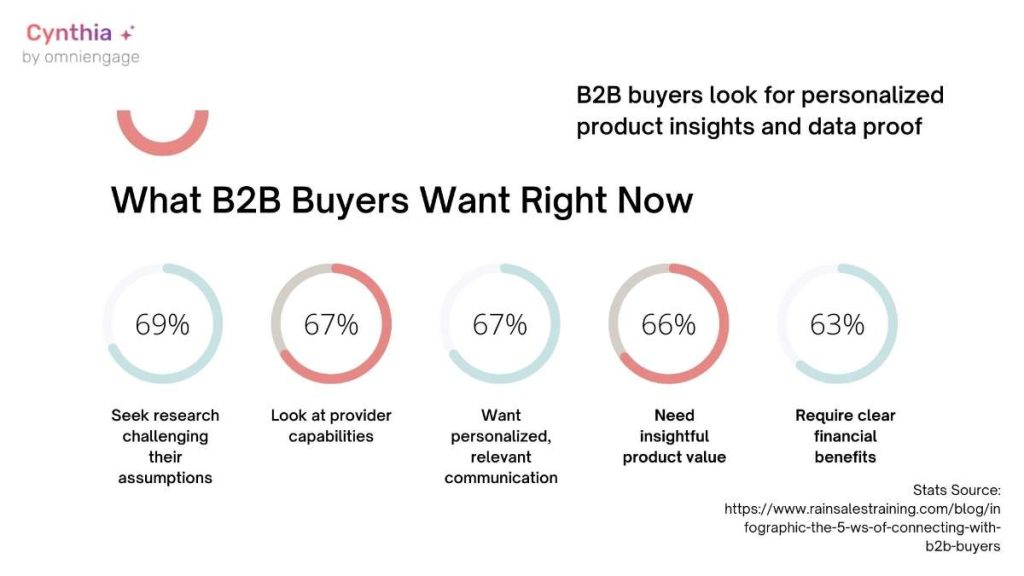
Let’s put this in perspective with research data from the RAIN group1. When making purchase decisions, B2B buyers are influenced by a clear hierarchy of factors:
- 69% prioritize primary research data that challenges their assumptions
- 67% focus on concrete provider capabilities
- 67% engage with customized content that speaks to their specific situation
- 66% seek deep product and service insights
- 63% require clear ROI and financial justification
The key to cutting through the noise isn’t just telling prospects you’re better—it’s showing them you’re innovatively different. This means your insights should disrupt their typical thinking patterns. When a prospect reads your message and thinks, “That’s interesting,” you’ve already won half the battle.
B2B buyers today demand personalisation that shows deep understanding, challenges their thinking, and provides clear, data-backed value propositions.
Are You Reaching Buyers Where They Want to Be Found?
The next question is – are you visible in the right channels? There’s a striking disconnect between how buyers want to be approached and how sales teams are actually reaching out.
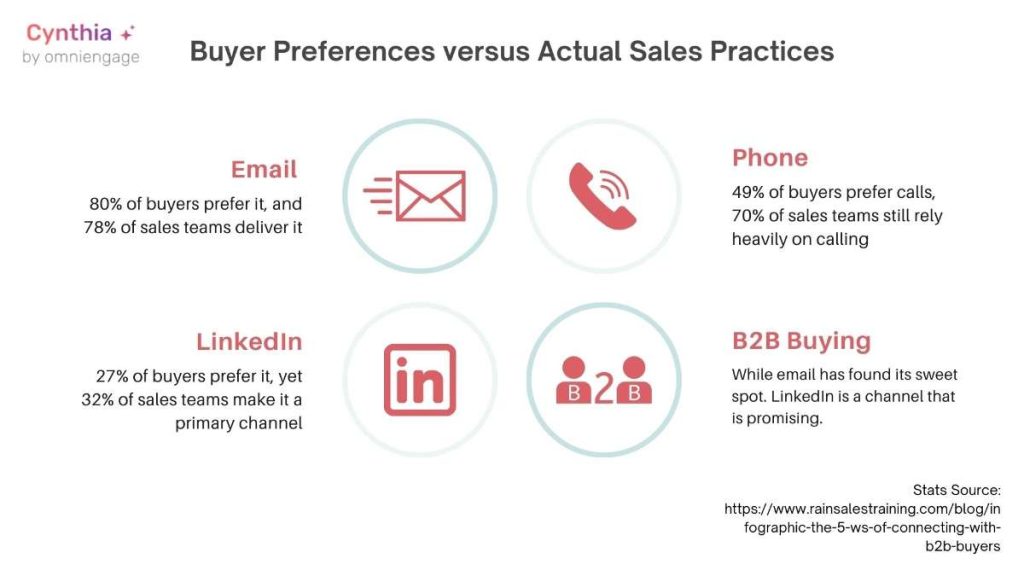
Let’s break down the reality of communication preferences versus actual sales practices1:
- Email shows near-perfect alignment: 80% of buyers prefer it, and 78% of sales teams deliver
- Phone calls reveal the biggest gap: while only 49% of buyers prefer them, 70% of sales teams still rely heavily on calling
- LinkedIn presents a promising opportunity: 27% of buyers prefer it, and 32% of sales teams already make it a primary channel
The data shows that while email has found its sweet spot, sales teams are significantly over-indexing on phone calls. Despite this, LinkedIn is a promising channel.
Understanding how your prospects prefer to engage can significantly enhance your outreach efforts. Now that we have evidence to support this, why wait to realign your communication strategy with buyer preferences?
The Prospecting Efficiency Gap
Why do some sales professionals seem to get more meetings effortlessly while others struggle? The data reveals an efficiency gap that separates top performers from the rest of the pack.
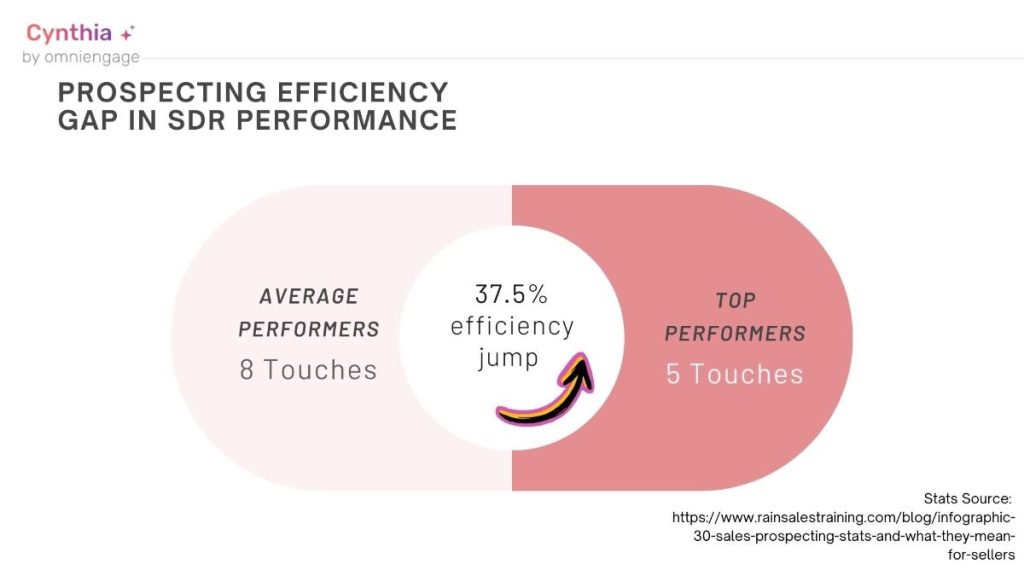
Top performers secure meetings in just 5 touches, while their average counterparts require 8 touches to achieve the same result3. This is a 37.5% efficiency advantage from working smarter. The secret? Top performers approach prospecting fundamentally differently.
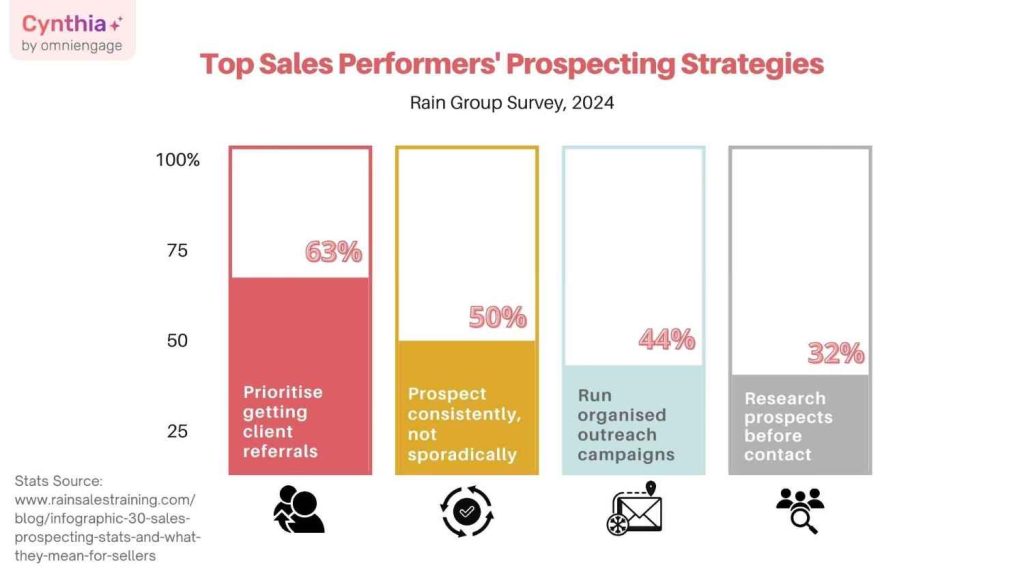
Four key strategies set these high achievers apart3:
- 63% make referral generation their top priority: bring-in existing relationships to open new doors
- 50% maintain long-term prospecting: their efforts are long term rather than relying on sporadic outreach campaigns
- 44% implement organised campaigns: their outreaches are planned according to targeted lists
- 32% hyper-personalise prospect communication: making sure to spend 2-3 mins researching prospects
The data highlights the difference between average and top performers in outreach. Average performers often use bulk, generic messages, while top performers focus on personalised communication that builds strong connections.
This targeted approach, combined with hyper-personalised communication, helps top performers secure more meetings and achieve higher conversion rates.
Ways to Personalise Sales Outreach at Scale
Personalisation at scale requires a systematic approach that aligns with the natural progression of sales prospecting.
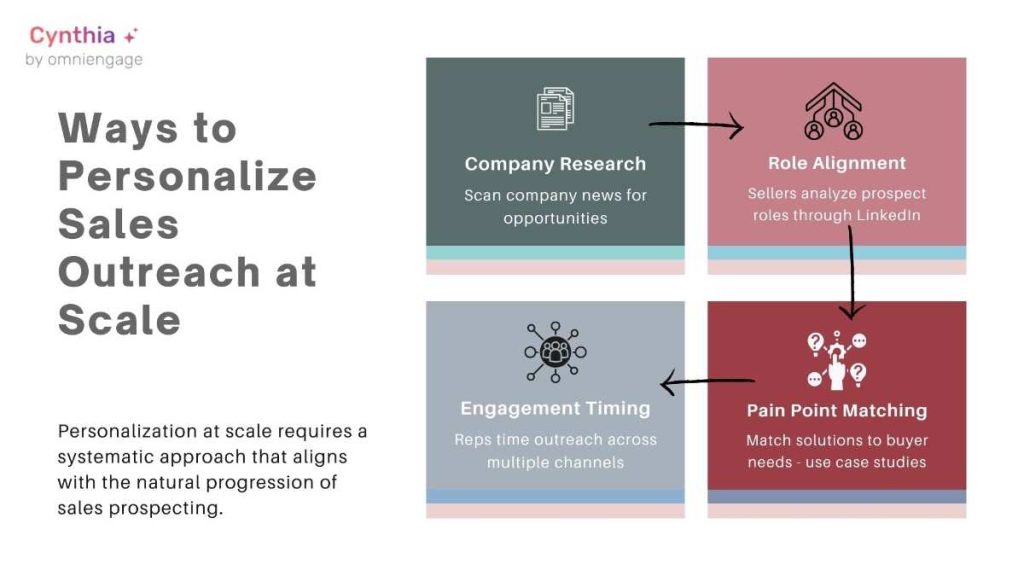
Level 1 – Company Research: Start Smart
Focus on events and recent company news that signal buying intent. The key is identifying the organisational size and decision-maker level that match your ideal customer profile.
Level 2 – Role Alignment
Combine CRM data with LinkedIn intelligence to understand your prospect’s experience, activity, and group participation. This delivers insights into their professional priorities and potential pain points.
Level 3 – Pain Point Matching
Share relevant case studies and ROI with your prospects. The goal is to educate them with new insights while demonstrating proven capabilities—without being spammy.
Level 4 – Engagement Timing: The Perfect Sequence
What works best is multi-channel touches with strategic downtimes between contacts. Each interaction should be customised and include clear calls-to-action, making it easy for prospects to take the next step.
Now, your traditional sales process can be turned into a scalable system while maintaining the personal touch that drives results. Every touchpoint builds on previous research, creating a cohesive pitch that resonates with your prospect’s specific situation.
But here’s where it gets interesting: When you power this framework with AI, the results become transformative.
Personalisation with AI SDRs: The Core Benefits
While this four-level framework provides a solid foundation, integrating AI SDRs can transform routine prospecting tasks into strategic advantages. Here’s how:
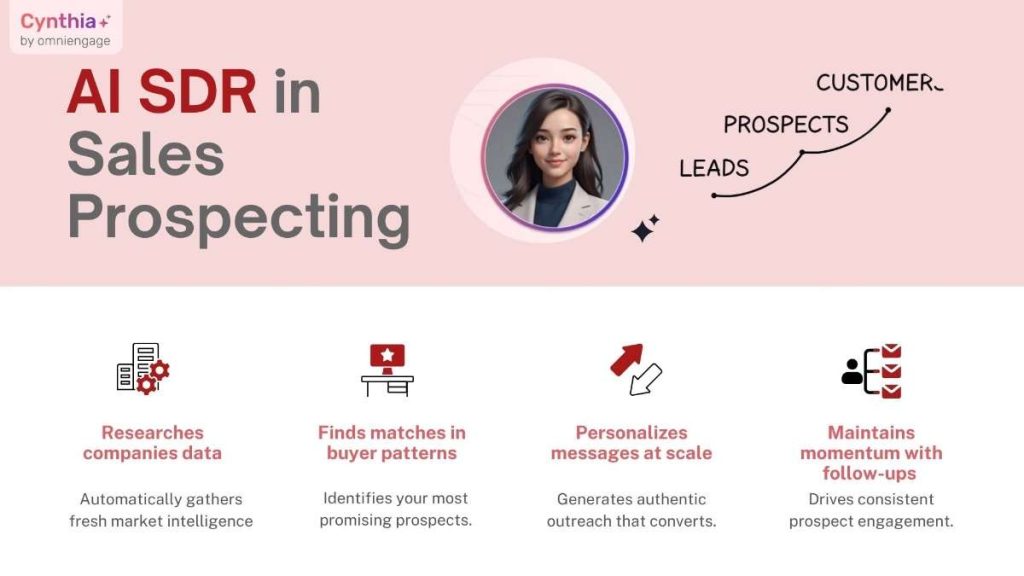
Automated Account-Level Research
Automated account-level research eliminates hours of manual data gathering. AI continuously monitors company developments, market shifts, and industry trends, surfacing relevant insights exactly when you need them.
Detailed Buyer Matching
A new way of identifying prospects – instead of manually scanning profiles and piecing together information, AI SDRs analyse patterns from your successful engagements to spotlight promising prospects.
Personalised Messaging
Personalised communications become both scalable and authentic. Rather than choosing between volume and quality, AI helps craft messages that maintain a personal touch while reaching more prospects. The system learns from successful interactions to refine its approach.
Intelligent Follow-Ups
Reduced unqualified lead time might be the most significant advantage. AI can automate campaign sequences so you can focus on high-value prospects, dramatically cutting time spent on leads that aren’t ready to buy.
AI SDRs free sales professionals to focus on meaningful conversations with the right prospects at the right time.
Deep dive into AI SDR challenges that can cause implementation issues for your sales team.
Best Practices: 5 Steps to AI Prospecting with Cynthia AI SDR
Do your sales teams need help personalising outreach more efficiently? Top-performing sales teams combine AI sales intelligence with human expertise to achieve three times higher response rates. Let’s explore five best practices with Cynthia AI SDR to transform your routine prospecting into a strategic advantage.
1. From Personalisation to Hyper-Personalisation
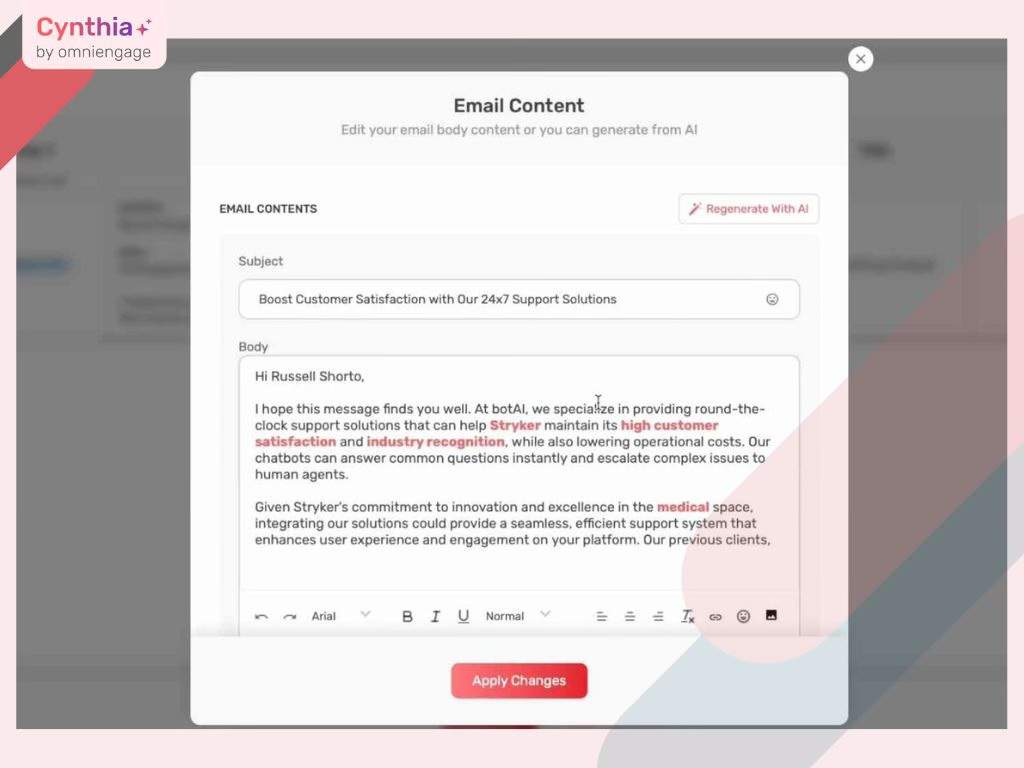
Cynthia AI goes beyond basic mail merge fields, analysing prospect behaviours, company signals, and industry trends to craft genuinely personal messages. This deep-level personalisation ensures each interaction is relevant and timely.
2. Create Strategic Multi-Channel Campaigns
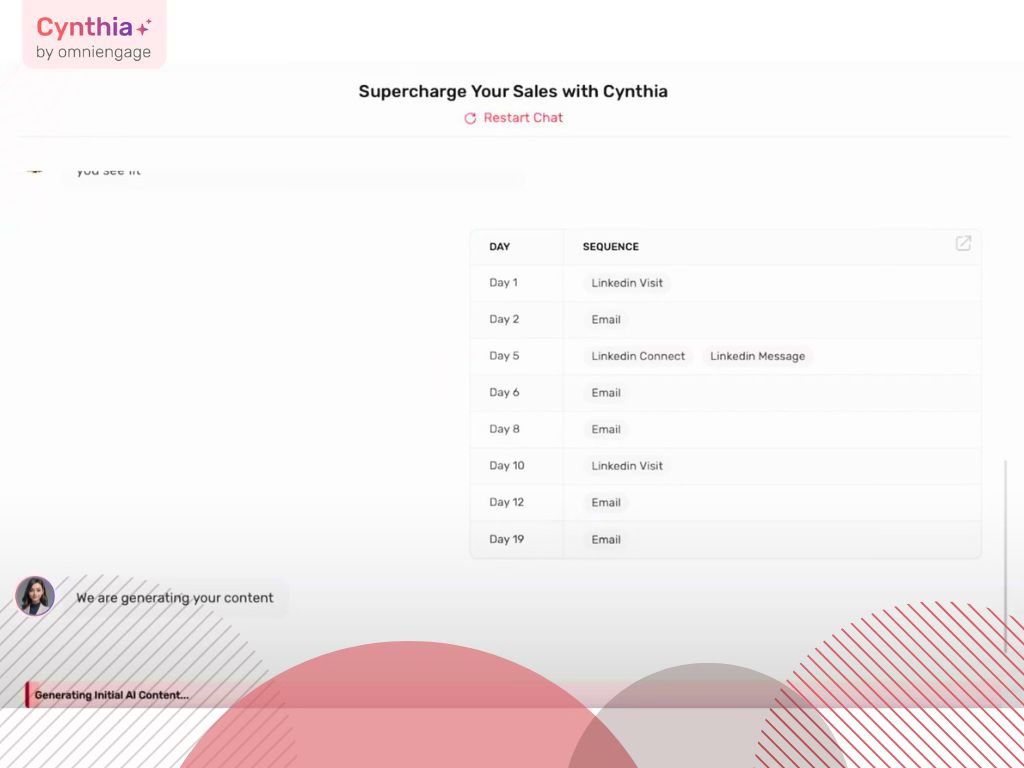
Rather than random outreach, Cynthia AI helps implement organised, multi-touch campaigns that follow proven engagement patterns. This systematic approach ensures consistent follow-up while maintaining flexibility for real-time adjustments.
3. Use AI for Value-Driven Pitch Angles
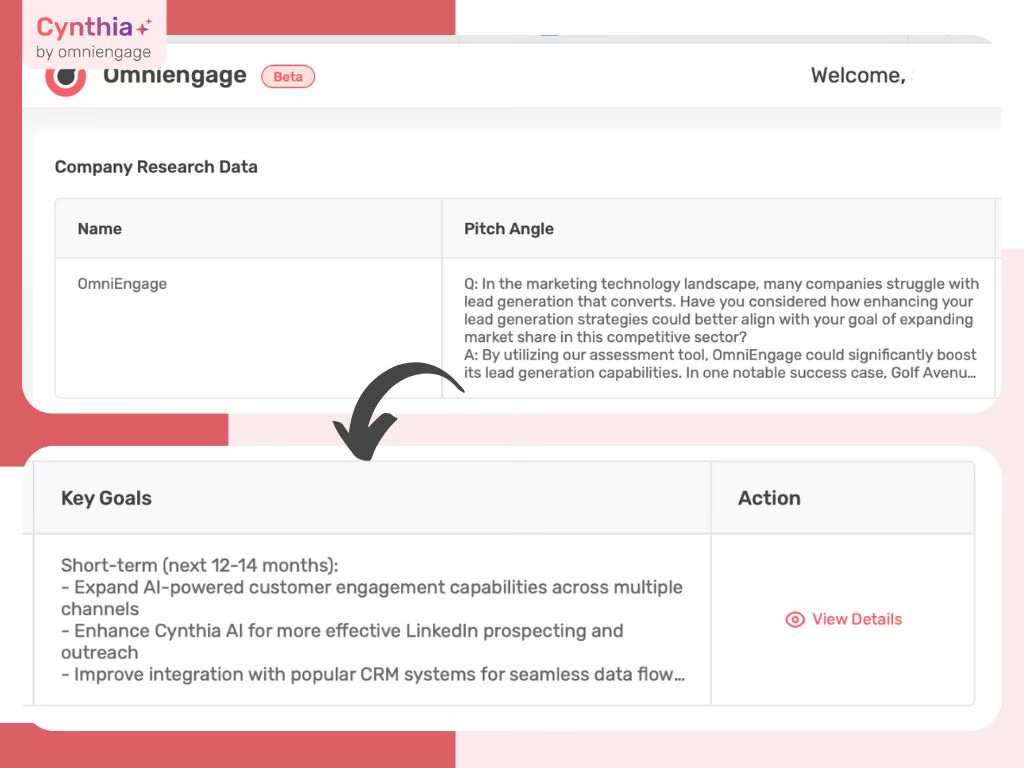
One of Cynthia AI’s standout features is its ability to identify value-based pitches relevant to opportunities within your network. From relevant pitch angles to key-goals identification for the prospecting company, Cynthia AI SDR does the research that human SDRs might miss.
4. Balance Automation with Human Touch
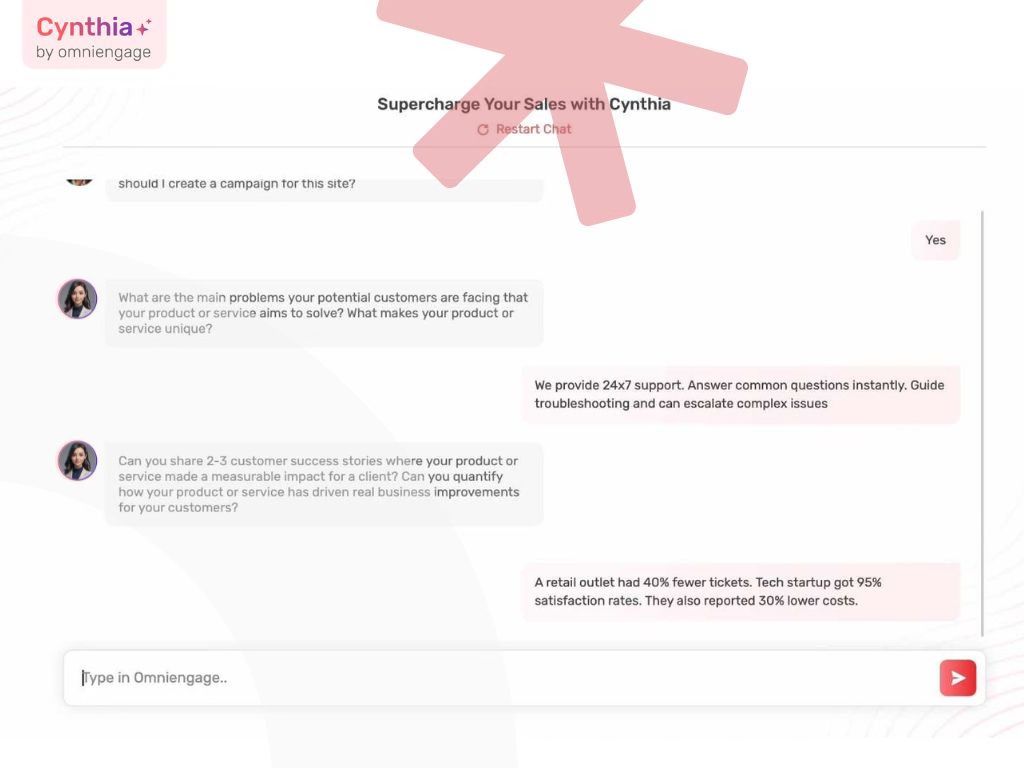
The key to Cynthia AI’s success lies in its ability to automate repetitive tasks while preserving authentic human connection. Enabling teams with a simple onboarding process, Cynthia AI SDR can research and do initial outreach. Additionally, Cynthia gives you the human-in-loop option to edit your prompt or sequences. Therefore, it helps sales teams focus on meaningful conversations.
5. Optimise with Specific Use Cases
Cynthia AI organises core sales activities into defined workflows that align with established sales processes. This includes every step, from company research, where you gather essential information about potential clients, to finding companies that match what you’re looking for in an ideal customer. From there, you can start seeing the right decision-makers within those companies to contact.

Conclusion
B2B sales is changing – while most tools send automated emails, Cynthia AI does the heavy lifting at every step. It researches companies, finds the right prospects, and creates personalised messages. This means your sales team can do smarter prospecting by eliminating repetitive research. You will have more time to focus on having real and meaningful conversations with qualified leads.
Want to see the difference in your sales process? Cynthia AI isn’t just another email tool – it’s your complete sales research and outreach AI agent. See how Cynthia AI stacks up against other sales tools at – Compare Alternatives. Get started for free, with no waitlist and no credit card required.

Further Reading
- 30 Must-Know Sales Prospecting Stats and What They Mean for Sellers, RAIN Group, 2024 ↩︎
- Smarter Selling with AI in 2023 by Hubspot ↩︎
- The 5 Ws of Connecting with B2B Buyers, RAIN Group, 2024 ↩︎