
Do you need help creating an effective omnichannel strategy for your business? With the influx of digital communication, catching people’s attention spans is competitive, and a good marketing plan is essential. This blog will guide you through making informed decisions about which channels to use. We’ll delve into how to deliver seamless user experiences across various consumer touchpoints. You can then craft an optimal omnichannel approach that can maximize campaign success.
A unified marketing communication platform, like omniengage.co, aids in analysing and predicting consumer behavior. This allows marketers to review their strategies continually. Read on to discover the critical elements of a winning omnichannel strategy.
Why is it important to know your customer’s needs?
When providing top-notch customer service, you must know your customers’ needs. By understanding your customer’s pain points and personas, you can better tailor your touchpoints across their journey. This will help you provide a more seamless experience that meets their needs and exceeds their expectations.
Your customers are the lifeblood of your business, so it’s essential to ensure they’re always happy. Understanding their needs ensures they have a positive experience when interacting with your brand. Not only will this result in more satisfied customers, but it can also lead to increased loyalty and word-of-mouth marketing.
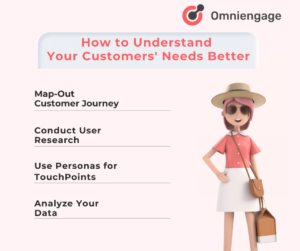
So, how can you go about understanding your customer’s needs? Here are a few tips:
- Map out your customer journey to help you identify the pain points and touchpoints.
- Conduct user research – talk to your customers and ask them about their needs and experiences.
- Use personas – these fictional representations of your target customers can help you understand their needs and preferences.
- Analyze your data – look at what customers are doing on your website and track their engagement with your content and products.
By taking these steps, you’ll be well on your way to understanding your customer’s needs and providing them with an excellent experience.
Tap Into Marketing Funnels To Find Your Customer’s Pain Points
Marketing funnels can be incredibly helpful in finding your customer’s pain points. By understanding what stage of the funnel your customer is in, you can better understand what they’re looking for and how to appeal to them.
Top of the Funnel
At the beginning of the funnel, customers are typically just becoming aware of their problem. They may still need to learn that a solution exists. So this is the perfect time to introduce them to your product or service and show them how it can help.
- Social media ads can introduce products or services to users who have yet to become familiar with the brand.
- Content marketing in the form of blogs, videos, or other valuable content can attract customers looking for information or solutions to problems.
- Another example is influencer marketing, where brands partner with social media influencers to promote their products or services to their followers, raising brand awareness and credibility.
Middle of the Funnel
As customers move down the funnel, they become more interested in finding a solution to their problem. Now, they’re looking for information about different options and how they can solve their issue. Therefore, it’s essential to provide this information and help them compare your product against others. Three examples of these consumer touchpoints are email campaigns, webinars, and social media engagement.
- Email campaigns can offer personalized demos or discounts to interested prospects.
- Webinars can provide educational content to build trust and offer exclusive deals.
- Social media engagement can help build brand loyalty and awareness by responding to comments, offering helpful information, and running contests.
Bottom of the Funnel
Finally, at the bottom of the funnel, customers are ready to purchase. They’ve decided that your product is their best option and are looking for the best deal. So you need to seal the deal and get them to buy from you. Three examples of these touchpoints are product pages, checkout processes, and customer service.
- Optimizing the product page by providing detailed information and clear CTAs can increase conversions.
- Simplifying the checkout process and offering multiple payment options can also help drive sales.
- Providing excellent customer service, such as fast delivery, easy returns and exchanges, and responsive support teams, can build trust and encourage repeat business.
By focusing on these consumer touchpoints, businesses can increase their chances of converting prospects into paying customers.
Mapping Consumer Touchpoints Across the User Journey
Mapping consumer touchpoints across the user journey involves identifying each interaction that a customer has with a business before, during, and after a purchase.
- Before a purchase, touchpoints may include online research, recommendations, or advertisements.
- During a purchase, touchpoints may include visiting a store or talking to sales associates.
- After a purchase, touchpoints may include using the product, returning it, or contacting customer service.
Optimizing each touchpoint can influence a customer’s decision-making process and overall satisfaction with a purchase. For example, businesses can create personalized and targeted content, offers, or services. These can range from targeted ads based on customer’s purchases or website activity, offering product demonstrations, or providing accessible customer service.
Steps to Analyze Consumer TouchPoints for Campaign Effectiveness
Once this data is unified and available at your campaign dashboard, you can plan to optimize these different consumer touchpoints in the user journey by:
Step 1.
Categorizing touchpoints by the type of interaction – such as digital or in-person, and note the emotional state of the customer at each stage. This can be done with customer feedback forms, social media listening tools, A/B testing your campaigns.
Step 2.
Analyzing each touchpoint to identify potential opportunities – for improvement, such as optimizing website content or streamlining the checkout process.
Step 3.
Developing a plan to improve the touchpoints with the highest impact on the customer journey and measure the effectiveness of those changes over time.
By mapping and optimizing each touchpoint, businesses can improve the customer experience and drive sales.
Omnichannel Content Distribution Strategies for E-commerce and SAAS
Businesses can use various content distribution strategies to reach consumers through omnichannel experiences. Push notifications, email marketing, chatbots, and social media targeting are some of the most common strategies used in eCommerce and SaaS. SMS marketing is also becoming increasingly popular, allowing businesses to reach consumers directly on their phones.
Each strategy has advantages and disadvantages, and businesses should consider the best.
- Push notifications allow businesses to instantly reach consumers on their phones with important information, such as new product releases or discounts.
- Email marketing is a great way to keep customers updated on new products, sales, and promotions, and chatbots can be used to answer customer questions in real time.
- Social media targeting allows businesses to target customers most likely interested in their products.
- SMS marketing allows businesses to reach consumers who may need internet access or typically do not shop online.
Ultimately, the best content distribution strategy will vary from business to business depending on their products, target market, and goals. However, using a mix of different methods is often the most effective way to reach consumers through omnichannel experiences.
Conclusion
Knowing your customer’s needs is essential for any business looking to provide a service or product. Where your customer is in a marketing funnel helps you pinpoint your customer’s pain points. You can then map out consumer touchpoints across the user journey to create an omnichannel content strategy that resonates with your audience. SignUp for Omniengage.co today to start creating workflows that make reaching customers with your marketing a breeze!